🎓 Want to Study in Korea? Your Guide to Exchange Programs at Top Korean Universities
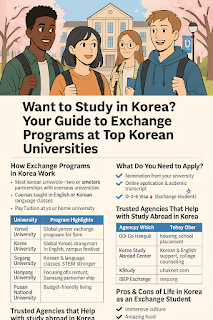
Are you dreaming of studying in Korea for a semester or two? You’re not alone!
Exchange student programs in South Korea have become incredibly popular, especially among students from the U.S., Canada, Europe, and Southeast Asia.
In this guide, we’ll walk you through:
- 📌 How Korea's exchange student programs work
- 🏫 The most popular Korean universities for exchange
- 📋 Required documents, visa tips, and language info
- 🤝 Trusted third-party agencies that help you apply
- ✅ Pros and cons of studying in Korea as an exchange student
Let’s dive into Korea’s exciting academic world!
🇰🇷 How Exchange Programs in Korea Work
Most Korean universities offer one or two semester exchange programs through official partnerships with foreign institutions.
You’ll usually:
- Be nominated by your home university
- Apply through the Korean university’s international office
- Take English-taught courses, or Korean language classes
- Pay tuition at your home school (tuition waiver)
Typical Duration:
- 1 semester (March–June or September–December)
- 1 academic year (March–December or September–June)
🏫 Top Korean Universities for Exchange Students
Here are some of Korea’s most foreigner-friendly schools:
| Yonsei University | Seoul | Global Yonsei Exchange, strong English course list |
| Korea University | Seoul | Buddy program, dormitories, campus festivals |
| Sogang University | Seoul | Jesuit tradition, high Korean language focus |
| Hanyang University | Seoul | Strong in STEM, great international community |
| Sungkyunkwan University (SKKU) | Seoul & Suwon | Modern meets traditional, Samsung partnership |
| Pusan National University | Busan | Relaxed vibe, ocean nearby, budget-friendly living |
| Chung-Ang University | Seoul | Renowned film/media programs |
| Ewha Womans University | Seoul | One of Asia’s best for gender studies, open to all |
✨ Search each school’s “Exchange Program” or “Office of International Affairs” for official pages.
🧾 What Do You Need to Apply?
- Nomination from your home university
- Online application to the Korean school
- Academic transcript (in English)
- Passport + ID photo
- Health certificate (some schools)
- Korean/English proficiency test (varies)
Once accepted, you’ll apply for a D-2-6 Visa (exchange student).
🗣️ Language Barrier? No Problem (Mostly)
Many courses are offered in English, especially at top universities.
However, Korean language courses are recommended (and fun!).
- Learn daily expressions 🗣️
- Make local friends
- Understand your environment better
💡 Tip: Bring a translator app + consider enrolling in Korean Language Institute classes.
🏡 Life as an Exchange Student in Korea
Pros:
- ✨ Immersive cultural experience
- 🥘 Amazing food
- 👫 Active student clubs + festivals
- 💳 Tuition waiver (usually)
- 🚅 Easy travel around Korea
Cons:
- 😅 Culture shock or loneliness
- 📚 Class format may be different (more independent)
- 💰 Living in Seoul can be expensive
- 🏢 Dorms may have curfews or shared rooms
🤝 Trusted Agencies That Help with Study Abroad in Korea
If your school doesn’t have a direct exchange program, don’t worry.
These organizations help you apply as a study abroad or language student:
| Go! Go! Hanguk | Housing, school placement, visa help | gogohanguk.com |
| Korea Study Abroad Center (유학네트) | Korean & English support, college counseling | uhaknet.com |
| KStudy | Focus on university application + D-2 visa | kstudy.co.kr |
| ISEP Exchange | Partnered global network | isep.org |
🧳 Real Student Tips
- 📱 Use KakaoTalk for all communication
- 🏠 Reserve dorms early (they fill up fast)
- 🥬 Try dormitory food—it's cheap and delicious
- 🎓 Join school clubs to meet locals
- 🚨 Always bring your ARC (Alien Registration Card)
📷 Bonus: Instagrammable Campuses
Korean university campuses are beautiful, especially in spring and fall.
Don’t miss cherry blossoms at Kyung Hee University or fall leaves at Yonsei.